
The Galactic War map in Helldivers 2 is the star chart on your Super Destroyer's bridge, and it shows every planet in the war, which faction holds it, how far liberation or defense has progressed and where enemy attacks are coming from. Learning to read it tells you which planets your missions will actually help. This guide walks through the map's layers as they work in November 2026, from supply lines and planet health to the impact rules behind every percentage.
We checked this against the official live war data, the Helldivers wiki's war mechanics page (updated 31 October 2026) and Arrowhead's patch notes on Steam.
What the Map Shows at a Glance
The war spans a lot of territory. The official war data for the current war season lists 273 planets, grouped into named sectors around Super Earth at the center. Three enemy factions push in from different directions: according to the wiki, the Terminids hold the eastern sectors, the Automatons the south-western sectors, and the Illuminate, who returned in December 2024, attack from the south.
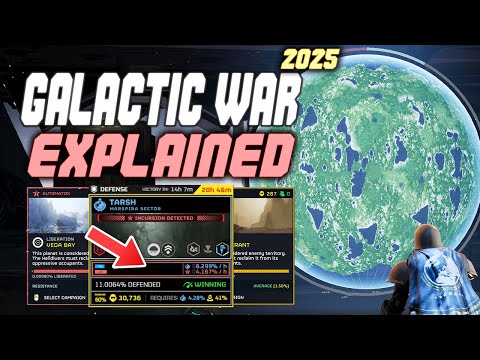
Planet nametags tell you who owns what at a glance. On the wiki's description of the map, Super Earth planets have blue nametags and Automaton planets red ones, and incoming planet attacks appear as red arrows pointing from the attacking world to the target. Active campaigns are the planets you can actually deploy to, and each shows a progress bar for liberation or defense when you select it.
Some planets can be hard to see. The wiki notes that the Gloom and black holes have obscured parts of the Galactic Map at different points in the war, so a region that looks empty may simply be hidden. Selecting a planet opens its details: owner, biome, hazards, active effects and the current percentage, which is where the useful decisions happen.
Supply Lines and Who Can Attack Where
The thin lines connecting planets are warp links, which the community usually calls supply lines. They are the rules of movement for the whole war. A planet can only attack another planet it is linked to, and Super Earth can only open a liberation campaign on an enemy planet that is linked to at least one Super Earth world.
That rule creates the map's strategy. If every link to a planet is cut, the wiki explains that new operations there cannot start and the planet keeps decaying, so a liberation can stall simply because a neighbor fell. The reverse also works in your favor: when an enemy planet is completely surrounded by Super Earth planets, it is sieged, its decay becomes negative and it liberates itself at about 1 percent per hour. That siege behavior became automatic around 16 June 2025, replacing manual adjustments by Arrowhead.
Defenses have their own markers. The wiki notes that a planet launching an attack on a Super Earth world shows flashing circles and shield icons in game, so you can see both ends of an attack at once. That matters for the gambit tactic described below, because the source planet is the one you would need to liberate.
When you look at the map, trace the lines first. A planet with several enemy links is a likely future attack target, and an enemy world with only one link back to its faction is a candidate for a siege. Thinking this way is how the community decides which planets to prioritize when there is no order telling it where to go.
Liberation, Defense and the Numbers Behind Them
Every campaign on the map is one of a few types. Liberation campaigns have no time limit but suffer enemy decay. Defense campaigns have a timer and no decay. Urgent liberations work like defenses but in reverse, with Super Earth attacking. High-priority campaigns appear for major story moments and come with very high decay that drops as milestones are reached.

Behind each progress bar is a pool of planet health. The wiki lists a default maximum of 1,000,000, with some biomes, including Magma, Deciduous, Autumn and Oasis worlds, set to 2,000,000. Cities and factories add more: a Settlement adds 100,000, a Town 200,000, a City 400,000 and a Megacity 600,000, while Automaton Megafactories add between 1 and 2 million depending on class. Capturing a region on the surface damages the planet by one and a half times that region's health, which is why region objectives are worth prioritizing on city worlds.
Defense works differently. A defense campaign's health is its defense level multiplied by 50,000, and its timer is 24 hours by default or 48 hours on planets with a Megacity or Megafactory and on Magma, Deciduous or Autumn Forest and Oasis planets. The map also offers a shortcut called a gambit: if the community liberates the planet an attack is coming from before the defense timer ends, the defense resolves in Super Earth's favor. Spotting a gambit on the map can save a planet faster than defending it directly.
Impact: How Your Missions Move the Bar
Your missions turn into "impact," and the rules explain why some sessions seem to do nothing. According to the wiki's mechanics page:
- Impact is generated only when you complete a mission's main objective.
- Harder missions hit harder: Trivial and Easy deal no impact at all, while a single Super Helldive mission deals 102.
- Completing a full operation adds bonus impact, from 136 on Trivial up to 408 on Super Helldive.
- Impact is then multiplied by the Galactic Impact Modifier, which is tied to how many missions are being completed across the war in a rolling 30-minute window, roughly reflecting the share of players rather than the raw count.
Enemy decay pushes the other way. On liberation campaigns, a fixed percentage of planet health regenerates every hour, unrelated to mission difficulty, and the wiki notes a ramp-up delay, so progress can take a few hours to show after players move to a new planet. Defense campaigns have no decay at all; any decay figure you see for one in a companion app is cosmetic.
The practical lesson: finish your main objectives, play the highest difficulty your squad can reliably clear, and concentrate on the same planets as everyone else. Spreading out over many planets fights decay on all of them at once. Since every platform shares one war, PC, PS5 and Xbox squads all pull on the same bars, as our crossplay guide explains.
Campaigns, Orders and the Control Center
The map is also where you see the community's current objective. Major Orders highlight their target planets and show progress, and since the 6.3.0 update on 16 June 2026, those orders sit inside Galactic War Campaigns that run for roughly one to three weeks. The Control Center terminal opposite the armory adds the story context, the reward at stake and an archive of earlier Campaigns. Our Major Order guide covers the live order and how Campaign rewards work.
The Democracy Space Station also appears on the map. The wiki's mechanics page describes it as voted on every four hours from high-population planets and providing a 10 percent liberation boost where it sits, with Tactical Actions that change how campaigns behave. Our DSS guide explains the vote and each Tactical Action.
Arrowhead has also described a bigger change to how planets are fought over. In June 2026 the game director called Planet Warfronts "the next big thing" for the Galactic War, with missions grouped into Defend, Frontline War and Behind Enemy Lines categories and fights for key locations such as cities. As of our November 2026 check of Arrowhead's Steam announcements, no patch had shipped Planet Warfronts, so treat it as planned rather than live.
Hazards and Modifiers to Check Before You Drop
The planet details panel is worth a few seconds before every deployment, because several modifiers show up there or in dispatches:
- Illuminate Exostorms: added in March 2026, these storms of high wind and lightning are visible on the Galactic Map, though their danger ramps up once you are on the surface. Destroying Exospires calms them.
- Bug caves: since 3 November 2026, Terminid cave networks can appear across more biomes, not just a handful of worlds, which favors close-range weapons.
- Arsenal Augmentations: dispatches sometimes make a stratagem free on one front for a set time, such as 48 or 120 hours.
- Enemy variants: fronts can carry special enemy groups, like the new Noxious Terminid strain announced in November 2026.
Reading these together tells you what to pack. An Exostorm planet calls for a different loadout than a cave-heavy bug world, and a free stratagem frees up a slot. Our Illuminate guide and Automaton guide go deeper on matching a loadout to each front.
Want Your Ship Ready for the Front?
The map tells you where to fight, but your progress decides what you can bring. If you would rather not grind Requisition, medals and ship modules before tackling the hardest fronts, the store's Helldivers 2 boosting hub lists those services along with Super Credits and level boosts for Steam and PlayStation. Availability changes, so check current availability on each listing first. Xbox is not covered by the hub.
Frequently Asked Questions
How many planets are in the Helldivers 2 Galactic War?
The official war data for the current season lists 273 planets across all sectors, though not every one has an active campaign at any time.
Why is my planet's liberation going down?
Liberation campaigns suffer enemy decay, a fixed share of planet health regenerating every hour. If too few players finish main objectives there, decay outpaces their impact.
What do the lines between planets mean?
They are warp links, often called supply lines. Planets can only attack linked planets, and Super Earth needs a link to an enemy world to open a liberation campaign there.
What is a gambit in Helldivers 2?
Liberating the enemy planet that an attack comes from before the defense timer runs out. If it succeeds, the defense ends in Super Earth's favor.
Do failed missions count toward liberation?
Impact comes only from completing the main objective. Failing before that point contributes nothing to the planet's progress.
Will the Galactic War ever reset?
The wiki describes the war as sequential and directed by a game master, and it is unknown whether it will ever be reset.