
Signs are Geralt's magic, and with the right skills they stop being a sideshow and become your primary way of winning fights. A dedicated signs build leans on Igni to delete groups, Quen to stay alive, and Yrden or Aard for control, all powered by one core stat: Sign Intensity.
The skill effects, gear bonuses and mutation details below were cross-checked against the Fextralife Witcher 3 wiki, PowerPyx guides and community discussion on Reddit in October 2026, and reflect the Next-Gen and Blood and Wine systems.
Why Sign Intensity is the whole build
Every sign scales off Sign Intensity, shown as a percentage on your character screen. Igni's burn damage, Quen's shield strength, Yrden's slow and Axii's hold all grow as that number climbs. Stacking intensity from skills, gear, decoctions and the Petri's Philtre potion is what separates a sign build that chips at enemies from one that outright kills them.
Because of that, almost every decision in this build asks one question: does it raise Sign Intensity or let you cast more often? If the answer is no, it is probably not worth a slot.
There is a useful threshold to aim for with Igni specifically. Once your Sign Intensity climbs high enough, Igni reliably applies the burning status on hit rather than occasionally, and burning is a damage-over-time effect that also staggers many enemies. Reaching that reliable-burn range is a milestone that changes the sign from a nudge into a genuine kill button, so when you plan gear and skills, treat pushing intensity upward as the project rather than a nice-to-have.
It is also worth understanding that signs run on the same stamina pool that caps your casting rate. A signs build therefore lives or dies on two numbers at once: how hard each cast hits (intensity) and how often you can cast (stamina regeneration). Neglect either and the build stutters, which is why the gear and alchemy choices later in this guide repeatedly come back to stamina as much as to raw intensity.
The core Signs skill tree
Spend your early points in the Signs (blue) tree and keep them concentrated rather than spread thin. The standouts:
- Melt Armor — Igni hits reduce enemy armor, so sustained fire ramps up over a fight.
- Firestream — the alternate Igni mode, a continuous cone of flame that is excellent against crowds and slow heavy enemies.
- Active Shield — the alternate Quen mode; the bubble absorbs hits and can heal you from the damage it blocks.
- Far-Reaching Aard and Aard Sweep — turn Aard into a wide knockdown you can follow up on.
- Delusion (Axii) — opens extra dialogue options and persuades people, useful well beyond combat.
A common early mistake is dabbling across all three trees. A signs build wants most of its points concentrated in blue so that a handful of key nodes are fully invested rather than many nodes half-filled. The intensity passives in particular only shine once stacked, so going deep on a few beats going wide on many. Keep a few points spare for a general combat node for the moments a sign will not solve the problem, but let the blue tree be clearly dominant on your character screen.
Fill in the general sign-intensity passives as you go. You do not need every node, but a deep Signs investment plus a few supporting skills will carry most of the game.
A word on the two Quen modes, because it is the choice new mages get wrong most often. The basic Quen shield absorbs a single incoming hit and then shatters, which is fine for predictable fights. The Active Shield alternate mode instead maintains a bubble that drains your stamina while it holds and can heal you based on the damage it absorbs. Active Shield is stronger on paper but ties up your stamina, so many sign builds actually keep the basic shield for the freedom to cast Igni between blows. Try both and decide based on whether your fights are about survival or about dealing damage.
Do not ignore the Yrden alternate mode either. The Magic Trap variant lays a stationary rune that damages and slows anything stepping on it, which is a quiet workhorse against packs and against anything that likes to circle you. For a mage who leans on positioning, dropping a trap and funneling enemies into it while you cast is a reliable pattern.
Griffin School gear: the signs armor set
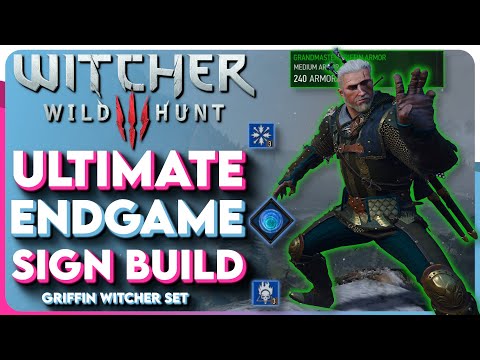
The Griffin witcher set is built for mages. Its pieces add flat Sign Intensity, and the set bonus increases the intensity of your next sign after casting one, rewarding you for chaining casts. The medium-weight armor keeps your stamina regeneration healthy, which matters because signs drain stamina.
You find the Griffin diagrams through a scavenger hunt that starts in Velen, and upgraded Enhanced, Superior and Mastercrafted versions appear as you level. Pair the armor with runewords and glyphs that favor Sign Intensity, and slot Greater Glyphs of Igni or Quen depending on which sign you rely on most. If you want a head start on this gear and the levels to wear it, the planning tips in our leveling guide pair well with a signs run.
If you own Blood and Wine, the Grandmaster Griffin set is the end goal. Its set bonus extends and strengthens the lingering effects of your signs, so a single Igni burns longer and a Yrden field lasts further into a fight. Reaching it takes the expansion's higher levels and a fresh scavenger hunt, but it is the clearest upgrade a dedicated mage can chase. Until then, do not feel locked into pure Griffin; mixing a Griffin chest with lighter boots or gloves to protect your stamina regeneration is a legitimate choice, since medium and heavy pieces slow how fast that bar refills.
Glyph choice deserves thought too. Greater Glyphs of Quen raise the amount of damage your shield soaks, Greater Glyphs of Igni nudge your intensity, and Glyphs of Reinforcement help if you find yourself dying before your casts do their work. The point is to bias every socket toward either hitting harder or surviving long enough to keep casting, which is the same principle that governs the whole build.

Potions, decoctions and oils that amplify casting
Alchemy supports a signs build more than people expect. Petri's Philtre is the signature potion here: it sharply raises Sign Intensity for its duration, turning a strong Igni into a devastating one. Keep it brewed and drink it before tough fights.
- Petri's Philtre — large Sign Intensity boost; the single most important potion for this build.
- Tawny Owl — restores stamina out of combat so you can cast more between swings.
- Ekhidna decoction — heals you whenever you spend stamina, including casting signs, which synergizes beautifully with frequent casting.
- Moon Dust bomb — strips enemy magic resistances, letting your signs land harder on wraiths and vampires.
Oils still matter even in a magic build, since you will swing a sword between casts. Keep the correct silver and steel oils applied for whatever you are fighting.
Adrenaline is the other resource to understand. As you fight and cast, you build adrenaline points, and certain Signs-tree skills let that adrenaline pour extra power into your next sign instead of being spent only on special attacks. A mage who keeps swinging between casts therefore keeps feeding bigger signs, which is one more reason not to stand back and cast passively. Stay in the fight, build adrenaline, and unload it through a boosted Igni or a wide Aard when the moment opens.
Mutations for a signs build
If you own Blood and Wine, two mutations stand out for mages. Piercing Cold transforms Aard into a freezing blast that can instantly kill frozen enemies and spreads to nearby foes, which is spectacular for crowd control. Conductors of Magic lets your sword attacks apply your active sign's effect, effectively doubling down on whatever sign you are leaning into. Both scale with Sign Intensity, so they reward the same stat you are already stacking. We cover the full list and the trade-offs in our mutations breakdown.
Between the two, Piercing Cold tends to win for a pure mage because freezing a whole group and executing the frozen enemies is simply the most efficient crowd clear in the game. Conductors of Magic shines more on a hybrid who still relies on sword swings, since every hit then carries, for example, Igni's burn. Whichever you choose, remember you can only run one mutation at a time, so build around the one that matches how you actually fight rather than trying to collect them all at once.
Skipping the setup with a ready save
The honest way to build a mage Geralt is to earn it: funnel points into the Signs tree, hunt down the Griffin diagrams, and keep Petri's Philtre stocked. That journey is a big part of why the build feels rewarding, and most players enjoy growing into it.
If you would rather skip the grind and start experimenting with a fully kitted sign caster right away, the all-in-game-unlocked NG+ starter save gives you a character with everything unlocked to arrange a signs build however you like. It is a save file delivered to your account across PC, PS4, PS5 and Xbox, not a cheat you run, and you still need to own the game. For more build ideas and the game's other systems, browse the The Witcher 3 page.
Frequently Asked Questions
What is the best sign for a signs build?
Igni is the main damage sign thanks to burn stacking and the Firestream alternate mode, while Quen keeps you alive. Most builds lean on both and use Yrden or Aard for control.
Which armor set is best for signs?
The Griffin School set. It adds Sign Intensity and its bonus boosts your next sign after you cast, which rewards chaining casts together.
Do I need Blood and Wine for a signs build?
No, a signs build works in the base game. Blood and Wine adds mutations like Piercing Cold and Conductors of Magic that make it even stronger.
What potion boosts Sign Intensity the most?
Petri's Philtre gives the largest Sign Intensity increase and is the signature potion for any mage build.
How do I keep enough stamina to cast signs?
Use medium armor like the Griffin set for faster stamina regen, drink Tawny Owl out of combat, and consider the Ekhidna decoction to heal while spending stamina.
Is Axii worth investing in?
Yes for utility. The Delusion skill unlocks persuasion dialogue, and the Puppet alternate mode can turn an enemy against its allies in a fight.