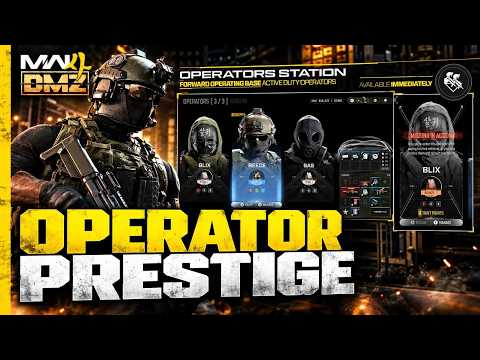
Operator Traits in MW4 DMZ are permanent upgrades you spend Trait Points on, and unlike the gear you carry into Hajin, they can never be lost. An Operator can hold up to 18 Trait Points worth of these perks, and they carry across every single deployment, making your Operator fundamentally tougher, faster and harder to put down the more you invest.
That permanence is the key thing to understand. Weapons, plates and backpacks are all on the line each run, but traits sit on the Operator themselves and persist whether you exfil or die. They are the closest thing DMZ has to a character skill tree, and this guide explains how the system works, what the perks generally do, and how it interacts with the rest of your progression.
What Trait Points actually are
Trait Points are a 0-18 pool of permanent upgrades attached to each Operator. You earn them through play and spend them on perks that improve survivability and efficiency, broadly falling into categories like keeping more of your gear on infil, moving and looting faster, and surviving longer in a fight.
Because the pool tops out at 18, you cannot have everything at once on a single Operator, which turns trait selection into a genuine loadout decision. The perks you pick shape how that Operator plays, so it pays to invest deliberately rather than spreading points thinly. Our guide to the best MW4 DMZ traits to unlock first covers which to prioritise.
Traits carry across every deployment
The headline feature is persistence. When you fail to exfil in DMZ, you lose your unsecured backpack loot and your Operator goes MIA. What you do not lose is your Trait Points. They stay with the Operator, so even a disastrous run leaves your permanent upgrades intact. This is what lets you take risks: your gear is expendable, but your core upgrades are not.
There is one cost worth knowing. If an Operator goes MIA, rescuing them costs DMZ Cash that scales with how many Trait Points that Operator had. In other words, your most upgraded Operators are the most expensive to rescue, which is a natural brake on recklessly throwing a maxed Operator into every fight.

The three broad categories of traits
Activision groups the benefits into a few themes. The first is keeping more of your gear on infil, which reduces how much you have to rebuild at the start of a run. The second is movement and looting speed, which lets you clear objectives and search containers faster, directly feeding your XP and cash per deployment. The third is raw survivability, helping you win the fights that would otherwise send you MIA.
| Category | Effect | Best for |
|---|---|---|
| Keep gear on infil | Deploy with more of your kit intact | Reducing rebuild time each run |
| Movement speed | Travel the map faster between objectives | Clearing more per deployment |
| Loot speed | Search containers and loot bodies faster | Cash and material farming |
| Survivability | Take more punishment and recover faster | Boss fights and contested exfils |
| Utility perks | Quality-of-life edges in the field | Rounding out a build |
Why traits matter more as you climb
Traits compound with your FOB and your level. A faster-looting, tougher Operator clears more objectives per run, which earns more DMZ XP, which climbs the 1-70 player level track and unlocks more of your base. The base in turn gives you better gear to survive longer and earn more Trait Points. It is a positive feedback loop, which is why early trait investment pays off well beyond its immediate effect.
The flip side is that neglecting traits leaves you fragile. If you find yourself dying before you can complete objectives, pouring points into survivability and infil-retention traits is usually a better use of your time than chasing the next weapon. For the companion weapon side, see our MW4 best guns guide, and for how Operators work overall, the DMZ operators guide.
Managing traits across multiple Operators
You unlock additional Active Duty Operator slots as you level, and each Operator has their own Trait Points. Many players specialise: one Operator built for aggressive boss hunting with survivability traits, another built for fast looting runs. Because the Stash, Bank and materials are shared, you can switch between specialised Operators without losing your resources.
Just remember the rescue cost scaling. A heavily invested Operator is expensive to bring back from MIA, so it can make sense to run risky objectives on a less-upgraded Operator and save your maxed one for the runs you intend to extract cleanly.
Earning the points to spend
If you want to build toward a full 18-point Operator quickly, the fastest path is efficient deployments: complete objectives, extract consistently and stack Double XP where you can. Our guide to earning trait points fast goes deeper on that grind, and if you would rather have the upgrades ready to use, you can have an operator level boost handled for you and come back to an Operator with traits already invested.


Traits versus gear: two different kinds of power
It helps to think of your strength in DMZ as coming from two separate sources that behave in opposite ways. Your gear, the weapons, plates and backpacks you print and buy, is powerful but fragile: it makes you strong in a given run and can be lost the moment that run goes wrong. Your traits are the reverse: they build more slowly, but once earned they are permanent and can never be taken from you.
That difference should shape how you value each. It is tempting to pour everything into a top-tier weapon build, but a looted gun lost on a bad exfil leaves you back at square one. A survivability trait, by contrast, keeps paying out on every deployment for the rest of your account's life. Over dozens of runs, the permanent upgrades quietly outvalue almost any single piece of gear.
This is also why traits and the FOB complement each other rather than compete. The FOB unlocks and gear let you survive long enough to complete the objectives that earn traits, and the traits then make you survive even longer, which earns more gear and cash. Investing in both, with a slight bias toward permanent upgrades early, gives you an Operator who gets steadily harder to kill rather than one who is only as good as their current loadout.
Specialising across multiple Operators
Because each Active Duty Operator carries their own 18-point pool and you unlock additional Operator slots as you level, traits reward thinking at the roster level rather than about a single character. Many experienced players run a small stable of specialists: one Operator built almost entirely for survivability to lead boss hunts and contested exfils, and another leaning into movement and loot speed for fast farming laps through safer districts.
This works so well because your Stash, Bank, Resources and Ingredients are all shared. Switching Operators costs you nothing in resources; you simply pick the right tool for the run ahead. It also interacts neatly with the MIA rescue cost. Since recovering a downed Operator scales with their Trait Points, you can throw your cheaper, less-invested specialist at the riskiest objectives and keep your expensive, heavily upgraded Operator for runs you are confident of extracting.
The one caution is not to dilute your points. It is better to have two or three Operators each committed to a clear role than a handful of half-built ones that are mediocre at everything. Decide what each Operator is for before you start spending, and let that identity guide every point you invest in them.
How to read a trait before you commit
When you are weighing whether a particular trait is worth a point, ask how often it will actually trigger. A perk that helps in every single deployment, like one that keeps more of your gear on infil or raises your baseline survivability, is almost always worth more than a situational one that only matters in a specific scenario. Permanent upgrades compound precisely because they fire so often, so frequency of benefit is the single best filter for your early points.
Frequently Asked Questions
How many Trait Points can an Operator have?
Up to 18. They are permanent upgrades spent on perks, and the 18-point cap means trait selection is a real build decision rather than unlocking everything.
Do Operator Traits carry across deployments?
Yes. Traits live on the Operator and persist whether you exfil or die, unlike the gear in your backpack which can be lost.
What do traits actually improve?
Broadly, keeping more of your gear on infil, moving and looting faster, and surviving longer in a fight. Activision groups them into those themes.
Does each Operator have their own traits?
Yes. Each Active Duty Operator has their own Trait Points, so you can specialise one for boss hunting and another for fast looting while sharing your Stash and materials.
Why is rescuing an Operator sometimes so expensive?
Because the MIA rescue cost scales with how many Trait Points that Operator had. A heavily upgraded Operator is the costliest to bring back, which discourages reckless play.
Are traits the same as the DMZ player level?
No. The player level is a 1-70 track that unlocks FOB stations and recipes. Traits are a separate 0-18 perk pool that upgrades the Operator directly.