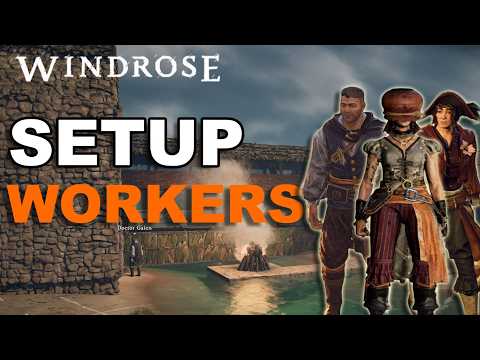
One of the systems that transforms Windrose from a constant hand-gathering grind into a comfortable adventure is recruiting NPCs. These recruits can be set to work speeding up harvesting and production, turning your base from a passive pile of storage chests into an economy that generates resources while you are off exploring, fighting, or sailing. Learning to build and deploy a workforce is one of the biggest quality-of-life jumps available, and this guide explains how to approach it.
Windrose is in Steam Early Access on PC from Kraken Express and Pocketpair, released 14 April 2026, so the recruitment and production systems are still being developed and balanced. I have kept specifics qualitative and cross-checked these systems against the official Steam store page, the game's Steam community discussions, and the Windrose subreddit, all checked in October 2026. The exact mechanics of recruiting and assigning NPCs may change with updates, so confirm the current details on your own save rather than treating anything here as permanent.
Why recruiting NPCs changes everything
The core problem a solo or small crew faces in Windrose is that there is always more to do than hands to do it. You need to gather, craft, build, fight, and sail, and every hour spent hand-gathering basic resources is an hour not spent adventuring. Recruiting NPCs solves this by letting your base do the repetitive gathering and production for you. Set your recruits to harvesting and production tasks, and your stores fill up in the background while you focus on the parts of the game you actually want to play.
This is why recruiting is such a pivotal step. Before it, your resource income is capped by how much time you personally spend gathering. After it, your base becomes a steady engine that produces materials around the clock of your play, and your personal time becomes free for the high-value activities, exploration, combat, and naval adventures, that a passive base cannot do for you. The shift from doing all the gathering yourself to overseeing a workforce that does it is one of the most satisfying progressions in the game.
This also changes how you should value your own time. Early on, when every resource comes from your own hands, it makes sense to gather whatever you pass. Once you have a workforce handling the steady supply of basics, your personal time becomes too valuable to spend on routine gathering, and you are better off letting your recruits cover the mundane while you chase the rewards only a player can earn, such as clearing a dangerous dungeon or raiding a distant island. Recognizing this shift and actually changing your habits around it is what unlocks the full benefit of recruiting. Players who keep hand-gathering basics long after their base could do it for them are leaving the system's biggest advantage on the table.

Set your workforce to the right tasks
Getting value from recruited NPCs comes down to assigning them well. Point your workforce at the resources and production you consume most, so your stores are filling with what you actually need rather than piling up materials you rarely use. Think about your bottlenecks: if you are always short of a particular material for your crafting and upgrades, that is where your recruits earn their keep. Matching your workforce's output to your consumption keeps your whole operation flowing.
Revisit these assignments as your goals change. When you are focused on building out your base, you will want recruits producing construction materials. When you are gearing up for naval expansion, your needs shift. A workforce that is set once and forgotten slowly drifts out of step with what you need, while one you periodically re-task to match your current project stays genuinely useful. Treat your recruits as a flexible resource you direct toward your current priorities, not a set-and-forget feature. Our Windrose crafting guide explains the material demands your workforce should be feeding.
Build a base that supports your workforce
Your recruits work within your base, so a base designed with them in mind gets far more out of them. Lay out your resource-processing areas, storage, and production stations so your workforce can operate efficiently, with the materials they produce landing where you can easily find and use them. A cramped or disorganized base limits what your recruits can accomplish, while a well-planned one lets your workforce hum along productively.
This ties base building and recruitment together as two halves of the same economy. As you expand from a simple shelter toward a proper fort, build with your growing workforce in mind, allocating space and infrastructure for the harvesting and production they handle. A base that is both a safe refuge and an efficient workplace for your recruits is the foundation of a thriving operation. Our Windrose base building guide covers designing that space in detail, and it pairs naturally with everything here.
Proximity is the practical principle to keep in mind. The less distance between where a resource is gathered, where it is processed, and where it is stored, the more your workforce accomplishes in the same time, because less of their effort is lost to travel. When you plan an expansion, try to cluster related production so the chain from raw material to finished good is short and self-contained. A thoughtfully arranged workplace can dramatically out-produce a sprawling one with the same number of recruits, simply because its layout wastes less of their time. Treat the efficiency of your base as a real variable you can improve, not a fixed backdrop, and your resource income will climb without recruiting a single extra hand.

Balance your workforce against your whole operation
Recruiting and maintaining a workforce is itself an investment, drawing on your resources and base capacity, so grow it in step with your needs rather than all at once. A handful of well-assigned recruits that keep your most-needed materials flowing is more valuable than a large workforce you cannot properly supply with tasks or housing. Scale your recruitment to match the size of your operation and the goals you are pursuing, so every recruit is contributing meaningfully.
Think of your workforce as part of a larger whole that includes your base, your gear, and your ships. The purpose of a resource engine is to fuel your ambitions, whether that is a fort, a warship, or simply the freedom to spend your sessions adventuring rather than gathering. Keep the size and focus of your workforce aligned with what you are actually trying to achieve, and it will quietly power the rest of your Windrose experience. A well-run workforce is the difference between a game that feels like endless chores and one that feels like a real adventure.
There is a quiet planning benefit to this as well. Because your base produces a steady, predictable stream of materials once your workforce is assigned, you can plan ambitious projects with confidence, knowing roughly how long it will take to accumulate what a fort expansion or a larger ship requires. That predictability turns vague ambitions into concrete timelines, and it lets you line up the next goal while your current resources are still gathering. A player gathering by hand lurches from shortage to surplus, while a player with a well-tuned workforce enjoys a reliable foundation to build on, which makes the whole game feel less like scrambling and more like steadily steering toward the things you want to achieve.
Recruitment is still evolving in Early Access
As with every Windrose system, remember that recruiting NPCs is still being developed in Early Access. The way you find, recruit, assign, and manage your workforce may change as the developers continue tuning the game, and new options may appear. Rather than relying on the exact current mechanics, focus on the enduring value: a workforce that handles your repetitive gathering and production frees your time for the parts of the game only you can do. That benefit holds no matter how the specifics evolve between updates.
It is worth checking in on your workforce periodically rather than setting it once and forgetting it, precisely because the game is still being tuned and because your own needs change. A workforce perfectly configured for your base-building phase may be producing the wrong things once you turn your attention to the sea, and an update may adjust how recruitment or production behaves. Treating your economy as something you revisit and refine, the same way you revisit your character build or your base layout, keeps it genuinely useful across the whole arc of a playthrough. A little ongoing attention transforms your recruits from a feature you unlocked once into an engine that stays matched to whatever you are currently trying to achieve.
A head start on a working economy
Building up a base, a workforce, and a smoothly running resource economy takes real time at the game. If you would rather spend more of your hours adventuring than establishing that foundation, you can browse options on the Windrose accounts and services page, which is an honest time-saver rather than a cheat. A working economy still has to be directed and maintained well, so use the principles in this guide to assign and grow your workforce wisely whatever your starting point. The reward is the same either way: more of your time spent on the adventure, less on the grind.
Frequently Asked Questions
What do recruited NPCs do in Windrose?
They can be set to speed up harvesting and production at your base, generating resources in the background while you explore, fight, and sail. This turns your base from passive storage into an economy that works for you.
Why should I bother recruiting NPCs?
Because it lifts the cap on your resource income. Instead of being limited by how much you personally gather, your base produces materials around the clock, freeing your time for exploration, combat, and naval adventures.
How should I assign my workforce?
Point them at the resources and production you consume most, targeting your bottlenecks. Revisit assignments as your goals change so your workforce stays in step with your current project rather than piling up materials you rarely use.
Does my base layout affect my recruits?
Yes. Recruits work within your base, so laying out processing areas, storage, and stations efficiently lets them accomplish far more. A disorganized base limits your workforce, while a well-planned one keeps it productive.
Should I recruit as many NPCs as possible?
No. Grow your workforce in step with your needs. A few well-assigned recruits keeping your key materials flowing beat a large workforce you cannot supply with useful tasks or housing. Scale recruitment to your operation.
Will the recruitment system change in Early Access?
Likely yes. Windrose is in Early Access, so how you find, recruit, and manage NPCs may change with updates. Focus on the enduring benefit of freeing your time, and verify current mechanics on your own save.