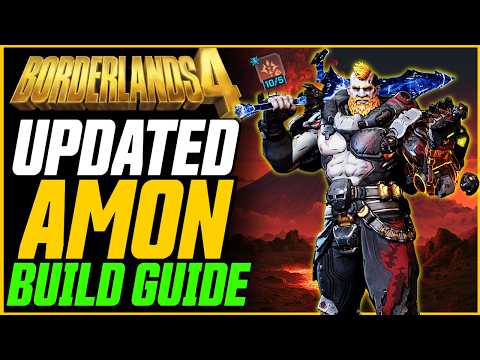
Amon is one of Borderlands 4's vault hunters, and like every character he supports several distinct builds that play nothing alike. The gap between an Amon that shreds endgame content and one that feels flat is almost never a single secret item; it is whether every skill point and every piece of gear points in the same direction. This guide gives you a durable framework for building Amon so you can adapt it as the game is patched instead of copying a list that quickly goes out of date.
Because Borderlands 4 is updated often, I have kept exact skill names, numbers, and item names qualitative on purpose. The framework here is cross-checked against the Borderlands Wiki on Fandom, the r/Borderlands4 community, and build coverage from IGN, GameRant, and Mobalytics-style resources, all checked in October 2026. Confirm any specific skill split, class mod, or gear roll in your own game, because balance changes regularly move the best choices around.
Choose Amon's core identity first
Everything starts with one decision made before you spend a point: what is Amon built to do? The three broad directions are raw weapon damage, action-skill and ability uptime, or a durable, control-oriented playstyle. The strongest builds pick one as the spine and treat the others as support. Trying to excel at all three at once produces a character that is merely adequate at everything, which falls apart in the endgame where you need a clear strength to lean on.
Study Amon's three skill branches and ask which one makes combat feel best to you. One branch will reward a particular damage or control approach, one will revolve around his action skill and the loops it enables, and one will typically offer defensive tools and sustain. Match your choice to the content you actually play, since a build tuned for the campaign can differ from one tuned for the hardest endgame modifiers. Picking for your real content keeps every point focused.
Write your plan as one sentence, such as "Amon built around keeping his action skill up as often as possible" or "Amon built around a single damage type." Everything that follows, from skills to class mod to weapons, should serve that sentence. If an exciting legendary pulls in a different direction, it is not part of this build, however strong it looks on its own.

Reading Amon's skill tree
Prioritize depth over breadth when you spend points. Rush down your chosen primary branch to reach its capstone, because that defining skill is usually the whole reason to build the branch, and the passives along the way only pay off once the capstone gives them something to amplify. Spreading points thin to grab several mid-tier skills across branches almost always yields a weaker Amon than committing hard to one branch first.
Favor multiplicative skills over flat bonuses. A skill that amplifies a damage type you already stack, or that extends your action skill's duration or shortens its cooldown, scales far better than a generic percentage boost. Watch for skills that build a self-sustaining loop, where a kill refreshes an ability or resource that helps you secure the next kill. Those loops keep Amon's power online through long fights and form the backbone of resilient endgame builds.
Spend leftover points deliberately once the main branch is complete. A shallow dip into a second branch for one high-value early skill, often defensive or utility, frequently beats the final few percentage points at the bottom of your primary tree. Respec freely as you test; Borderlands keeps it cheap so you can experiment until the split feels right for your content.
A common leveling mistake with Amon is judging the build before it has matured. Many strong plans feel underwhelming until their defining capstone and the gear that supports it are both online, and players who abandon a direction at the halfway mark never see what it becomes. Hold to your one-sentence identity through the awkward middle stretch, keep pushing points toward the payoff, and reserve judgment until the core is complete. Patience during that in-between phase is often the only thing separating a disappointing Amon from a dominant one.
Think about the path through the tree, not only its endpoint. Taking an early survivability or sustain skill first can make the entire climb smoother, keeping Amon in fights long enough to level efficiently before you pivot toward damage once established. The final shape of the build matters most, but a thoughtful order of acquisition keeps him comfortable to play the whole way up rather than leaving him fragile until the last stretch of levels.
Class mod and gear for Amon
Amon's class mod is his most build-defining item. The right mod boosts the specific skills at the heart of your one-sentence plan, and because class mods can push skills past their normal cap, they often unlock interactions nothing else provides. Always read the skills a mod boosts before its raw stats; a mod that adds points to your key loop skill beats a higher-stat mod that boosts skills you never use.

For weapons, match the manufacturer and archetype to your damage plan and carry a tight, deliberate loadout that covers your weaknesses rather than a pile of situational guns. If your build stacks a particular element, favor gear that applies and amplifies it, and always keep an option for the enemy types or ranges your main weapon handles poorly, so you are never left helpless when a fight does not play to your strength.
Round out the kit with a shield and throwable that reinforce Amon's identity. A shield whose effect triggers on a condition your build meets can anchor an entire playstyle, and the right grenade or ordnance plugs a gap such as crowd control or shield stripping. When every slot has a job that traces back to your core sentence, the build performs well beyond the sum of its individual card numbers.
Scaling Amon into endgame
A build that cleared the campaign can struggle in the hardest endgame, where enemies have far more health and modifiers rewrite the rules. As difficulty climbs, raw burst matters less and consistency, sustain, and ability uptime matter more. If your Amon relies on getting kills to stay powered, make sure he has a dependable way to score that first kill against tanky targets, or the engine stalls exactly when you need it most.
Expect to retune as you go. You might move a few points into defense or cooldown reduction, swap to a class mod with better survivability boosts, or shift gear priorities toward effects that provide uptime and protection over pure damage. Treating the build as something you adjust per activity, rather than a finished monument, is what separates players who clear the hardest content from those who stall at its doorstep.
Keeping a second saved loadout pays off here as much as it does for any vault hunter. The gear and split that crush a single durable boss are rarely the same ones that excel at clearing a room full of mixed enemies, and asking one setup to do both leaves Amon mediocre at each. Build a single-target loadout that leans into sustained damage and survivability, and a clearing loadout that leans into crowd control and mobility, then swap between them as the activity calls for. That flexibility is not excess optimization; it is simply how you meet the variety the endgame demands.
Co-op is worth planning around too. Enemies generally grow tougher as more players join, which rewards sustain and consistency over pure burst, and the best groups divide responsibilities so each character leans into a strength. If your team already has crowd control or a dedicated defensive anchor, you can push Amon harder toward damage, whereas a solo-heavy routine usually wants him carrying a little more self-sufficiency. Decide early whether Amon is your group's damage dealer or your self-reliant soloist, because that single answer shifts several of your skill and gear priorities.
Above all, understand your Amon build well enough to repair it when the game changes. Borderlands is a live game, and the specific skills, items, and interactions that make a build strong today will be tuned over time. Players who copied a list without grasping why it worked are stranded by every balance pass, while those who understand the loop at the heart of their Amon simply swap the affected piece and carry on. Learn the logic, not the list, and your character stays strong across patches instead of being rebuilt from scratch each time the numbers move.
Getting Amon's gear without the grind
A great Amon build still depends on finding the right class mod and gear, and that farming takes time. If you would rather play him than grind for parts, the store handles this openly. The prebuilt Borderlands 4 pure Amon build service is a direct way to get a ready, cohesive setup, and the full range is on the Borderlands 4 page. It saves time but does not replace understanding how he plays, so learn the logic too. Our guides on the Harlowe build and the C4sh build show how the right pieces tie a vault hunter together.
Frequently Asked Questions
How should I start an Amon build?
Decide his core identity first: damage, action-skill uptime, or survivability. Write it as one sentence and measure every skill and gear choice against it so the whole build points the same way.
Should I rush one branch or spread points?
Rush your primary branch to its capstone first, since that defining skill is usually the reason to build the branch. Spend leftover points on a shallow, high-value dip into a second branch afterward.
What gear matters most for Amon?
The class mod, because it boosts specific skills and can push them past their normal cap. Choose one that amplifies the skills at the heart of your plan, reading its skill boosts before its raw stats.
Why does my Amon fall off in endgame?
Endgame enemies have more health and modifiers change the rules, so burst matters less and sustain and uptime matter more. Expect to move points into defense or cooldown and adjust your gear.
Can I copy an Amon build from a video?
You can as a starting point, but understand why it works. When an item or skill is patched, players who grasp the underlying loop simply swap a piece, while those who copied blindly are stranded.
Are the exact numbers in Amon guides reliable?
Treat them as starting points. Borderlands 4 is patched often, so verify any split or roll in-game. The logic of a focused, loop-driven build lasts far longer than the specific figures.