
Once you have a weapon you love in Bloodborne, blood gems are how you make it genuinely powerful. They are socketed modifiers that boost damage, add elemental effects, or buff your weapon in other ways, and a well-gemmed weapon can deal several times the damage of an ungemmed one. Understanding how gems work is the single biggest step toward an optimized character.
Bloodborne released in 2015 and has not changed mechanically in years, so the details here are stable. I cross-checked the specifics against the Bloodborne Wiki on Fextralife, the Fandom Bloodborne Wiki, and the r/bloodborne community, all checked in October 2026. Where an exact numeric value could mislead, I have kept it qualitative and pointed you to verify it in-game or on the wiki.
Imprint slots and gem shapes
Every weapon has blood gem imprint slots, unlocked as you upgrade the weapon with Blood Stone material. Each slot has a shape, and each blood gem also has a shape. A gem can only be socketed into a slot whose shape it matches. The common shapes include radial, triangle, and waning, with some weapons featuring unique slot shapes such as droplet or circle on specific weapons.
This shape matching is the core constraint of the system. A radial gem fits a radial slot, a triangle gem fits a triangle slot, and so on. Because different weapons come with different slot layouts, the ideal gems for one weapon may be unusable on another. When players discuss a weapon's gem setup, they are really describing which shapes it has and which effects fit best in each.
You socket and remove gems freely at the workshop in the Hunter's Dream, and removing a gem does not destroy it, so you can experiment and move gems between weapons. This makes it worth collecting a small library of strong gems of each shape as you play.

The main gem effect types
Blood gems come with a wide variety of effects. The most straightforward and generally most valuable for a damage build is a flat or percentage physical attack increase, which simply multiplies the damage your weapon already deals. There are also gems that add elemental damage, converting or adding fire, bolt, or arcane damage to your attacks, which is the foundation of elemental and arcane builds.
Beyond raw damage, gems can boost specific damage types such as blunt or thrust, increase damage against beasts or kin, raise your stamina, add physical or elemental defense, speed up health regain, or improve your firearm's blood attack. Some gems carry secondary effects, both positive and negative, which is where the system gets deep. A gem might grant a large attack boost while slightly reducing another stat, and weighing those trade-offs is part of min-maxing.
I am deliberately not quoting exact percentage values here, because they vary by gem rating and the game has many tiers. The important concept is that gems scale with the depth of the dungeon they come from: deeper Chalice Dungeons yield higher-rated gems. Check the wiki for the precise numbers on any specific gem you find.
Cursed gems and their trade-offs
Cursed blood gems are the most powerful gems in the game, and they always come with a drawback. A cursed gem might offer an exceptionally high attack bonus paired with a penalty such as reduced defense, lowered stamina, or decreased health regain. The art of high-end gem hunting is finding cursed gems whose downside does not actually hurt your build.
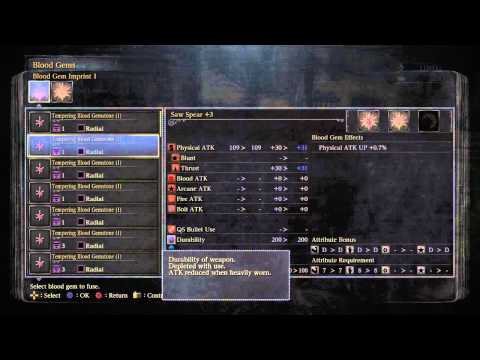
For example, a cursed gem that reduces a stat you do not rely on, or whose penalty is small relative to its enormous attack boost, can be strictly better than any non-cursed alternative. The best builds in the game are almost always built around a few carefully chosen cursed gems. These drop from deep and cursed Chalice Dungeons, which is why serious gem farming and Chalice Dungeons are inseparable.
Because cursed gems roll with varied effects, farming them is partly a numbers game. You run a dungeon known to drop the gem type you want, kill the enemies or boss that drop it, and hope for a good roll on both the main effect and the secondary. This is the endgame grind that defines Bloodborne's optimization scene.
Where to farm the best gems
Early gems come from regular enemies and story progression, and they are fine for a first playthrough. The serious gems come from Chalice Dungeons, and specifically from deep Root chalices and cursed dungeons. The community has catalogued glyphs, the seed codes for Root chalices, that reliably drop particular gem effects, so a common workflow is to look up a glyph for the gem you want and farm its boss or chest.
Specific enemy types and bosses in the deep dungeons are associated with specific gem drops, so efficient farming means knowing which dungeon and which target to repeat. Because this ties directly into the dungeon system, it is worth reading our full Chalice Dungeons guide alongside this one to understand the depth ladder and ritual materials you will need.
A practical gemming plan
For most players, a sensible approach is to not over-invest in gems until you have settled on your main weapon and completed the main story. During your first run, socket whatever decent gems you find that match your weapon's shapes and prioritize physical attack increases. Once you are into endgame and Chalice Dungeons, start targeting the specific effects your build wants, whether that is pure physical for a quality or Strength build or added elemental for an arcane setup.
Keep a few of the best gems of each shape in your storage so you can re-gem when you switch weapons. And remember that gem choice interacts with your scaling stat and your weapon's damage type, so the ideal gem for a Strength bruiser differs from the ideal gem for an arcane caster. Our arcane build guide covers how elemental gems reshape a weapon entirely.
How to read a gem's description
Every blood gem lists a primary effect and sometimes one or more secondary effects, which can be positive or negative. The primary effect is why you equip the gem, whether that is a physical attack boost, an added element, or a defense buff. The secondaries are the fine print: a small stamina penalty, a minor defense drop, or a bonus to a specific damage type. Reading the whole description matters, because two gems with identical primary effects can differ wildly once you account for their secondaries.
Gems also carry a rating that reflects their power tier, and that rating climbs with the depth of the dungeon that produced them. A low-rating physical gem and a high-rating one both read as a physical attack increase, but the stronger one can more than double the weaker one's bonus. This is why the community obsesses over deep dungeons: not for new effects, but for far higher ratings of effects you already have.
A simple gem plan for your first playthrough
For a first run you do not need to understand every secondary. Socket the highest-rating physical attack gems you find that match your weapon's slot shapes, and you will be comfortably strong for the whole main story. Keep an eye on shape, since a great gem you cannot socket does you no good, and hold onto spares in storage rather than selling them, because a weapon you pick up later may want them.
Save the deep optimization for after you have beaten the game and settled on a main weapon. Only then is it worth farming specific dungeons for cursed gems with the exact secondary profile your build wants. Approaching gems this way, casual during the story and focused in the endgame, spares you a lot of early frustration while still leaving the door open to a fully maxed hunter later.
A couple of shape-specific details are worth internalizing as you collect. Radial slots are the most common on many weapons and tend to accept the broad, high-value attack gems, so they are usually where your biggest flat damage boosts go. Triangle and the rarer waning slots often carry gems with useful secondary effects, and waning gems in particular are associated with some of the strongest cursed options. Beyond shape, always weigh a gem's downside against your actual build before equipping it: a cursed gem that drains your health regain is far more dangerous on a low-Vitality glass-cannon hunter than on a sturdy quality build, and a stamina penalty hurts a heavy weapon more than a quick one. There is no universally best gem, only the best gem for the weapon and build in front of you, which is exactly why the system supports such deep experimentation once you reach the endgame. Keep that mindset and the dense numbers quickly become far less intimidating.
Skipping the farm when you already own the game
Gem farming is one of the most time-intensive parts of Bloodborne, and it is pure repetition. If you own the game and would rather enjoy a fully kitted character than grind dungeons, the store offers a Bloodborne modded save, with the full range on the Bloodborne page. It is a convenience for existing owners who want to skip the grind, not a replacement for understanding how gems make a weapon shine.
Frequently Asked Questions
How do blood gem slots work in Bloodborne?
Each weapon has imprint slots with shapes such as radial, triangle, or waning, unlocked by upgrading the weapon. A gem can only go in a slot whose shape it matches.
What is the best blood gem effect?
For most damage builds, a physical or percentage attack increase is the most valuable because it multiplies your weapon's existing damage. Elemental gems are key for fire, bolt, or arcane builds instead.
What are cursed blood gems?
Cursed gems are the most powerful gems in the game, offering a large bonus paired with a drawback like reduced defense or stamina. The goal is to find cursed gems whose penalty does not hurt your build.
Where do I farm the best blood gems?
The best gems come from deep Root and cursed Chalice Dungeons. Players use known glyph seeds to reach dungeons that reliably drop specific gem effects, then farm the relevant boss or enemy.
Can I move gems between weapons?
Yes. Removing a gem at the workshop does not destroy it, so you can freely swap gems between weapons. Keeping a library of strong gems of each shape is worthwhile.
Do I need perfect gems to finish the game?
No. Decent gems you find during a normal playthrough are enough to beat the main story and DLC. Optimized cursed gems are for pushing a build to its maximum in endgame content.